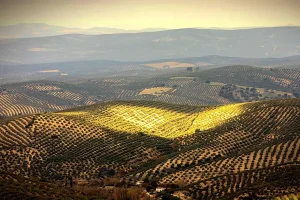
The olive tree has accompanied Mediterranean man since ancient times, it is among the most cited trees throughout history: the dove sent by Noah returned with an olive branch in its beak; in the legend about the founding of Athens, Minerva (Athena) gave the city the best gift, an olive tree. It has been part of the Mediterranean culture and way of life, providing raw material for lighting, medicinal ointment and revitalizing liquid for the human body.
It comes from the area between Asia Minor and the coasts of Syria, Lebanon and Israel. Its arrival in Europe probably took place at the hands of the Phoenicians, but it is the Romans who promoted its cultivation in Baetica. The Arabic influence remains in words such as oil (az-zait) and oil mill (ma’sara).
The olive tree (Olea europaea) comes from the wild olive tree, a characteristic element of the Mediterranean forest. The main variety in the Sierra de Cazorla region, the Picual, is highly appreciated for the quality and stability of its oils; the Royal, for its excellent organoleptic particularities, such as a very intense fruitiness and great softness. Almost all the olives produced are used to obtain oil.
The cultivation of olive trees is the basis of the regional economy, along with rural and natural tourism. In the Sierra de Cazorla region, 43,641 hectares correspond to olive groves, of which more than 60% are rainfed olive groves. This means that of the total cultivated area in the region, 47,048 hectares, 92.76% is olive groves (IECA 2018) and almost 40% of the active population is dedicated to work related to olive grove cultivation and the production of oils in all its categories. There are currently 7 agricultural cooperatives and 17 private oil mills (RIA. August 2024). To verify the importance and volume of the sector, the figures for an average campaign are usually around 180 million kilos of olives, which translates into more than 30 million kilos of oil.
The cultivation tasks are: tillage, fertilization, pruning, irrigation and harvesting. The latter is the one that generates the most labor. The ideal date to start it depends on the years and coincides with the time when the fruit has the maximum amount of oil. The campaign should not be prolonged over time to prevent the fruit from falling to the ground, which would decrease the quality of the oils obtained. It is usually held from October to March.
Vareo is the traditional technique. It is done with long sticks with which the olive tree is beaten so that the olive falls on the shawls. In front of them are the pickers (work generally carried out by women) who collect the olives that have fallen to the ground. To ensure the quality of the oils, the olive in the ground is separated from the “flight” one. The rods are gradually being replaced by vibrators. When the harvest is finished in a pit, the remate or “botijuela” is usually celebrated, eating, drinking and enjoying the end of the harvest with songs and dances.
The olive is transported to the oil mill in tractors or trailers and the extraction of the oil begins after its reception, washing and weighing.
Traditionally, the milling was carried out in mills or “empiedros” and the oil was extracted by means of a system of presses, in which the beaten paste was placed on the “capachos” (cylindrical mats, generally made of esparto grass) stacked around a central needle, subjecting them to pressure, draining the oil and alpechín or jamila (vegetation water) and retaining the pomace (solid fraction made up of remains of pulp and bone). To separate the oil from the vegetation waters, it was introduced into batteries of wells or jamileras, in which the water of lower density remained at the bottom, passing the oil with less and less humidity through the different vessels. Finally, it was stored in the presses (underground deposits).
Currently, the mills are made of hammer metal and the separation of the oil is carried out by decanter, which after adding water to the paste, subjects it to a centrifugation process, separating the oil, pomace and alpechín (three-phase system). This system is being replaced by the two-phase system. The extracted oil must be purified of small solid residues (by means of filters and sieves) and vegetation water (in vertical centrifuges). Finally, to ensure the maintenance of the quality of the oil obtained, storage is carried out in tanks built with inert materials, avoiding exposure to light and aeration.
The product obtained with care throughout this process is extra virgin olive oil: authentic oily juice extracted only by mechanical or other physical procedures and in thermal conditions that do not alter the quality. Its acidity must be less than 1% and it must not have organoleptic defects. The excellence of our extra virgin olive oil has earned it the “Sierra de Cazorla” Designation of Origin.
COUNTRYSIDE AND MOUNTAIN OLIVE GROVES
Broadly speaking, two areas can be distinguished. On the one hand, the countryside, traditionally used for the cultivation of cereals, and which in recent years has been transformed mostly into olive groves, generally irrigated and of the PICUAL variety. However, there is a growing number of plantations of the native variety ROYAL, in response to the growing demand for the oils it produces.
On the other hand, we have the mountain area, in the heart of the Sierras de Cazorla, Segura and Las Villas Natural Park, destined to the cultivation of rainfed olive groves, in which picual and royal olive trees alternate in a traditional distribution that establishes the differentiating character of the Sierra de Cazorla Extra Virgin Olive Oils. In these areas, the traditional olive grove is still preserved with specimens of centenary olive trees that make up a true natural and cultural marriage. These olive groves generally correspond to small plots managed directly by the owners, who with their work manage and control all cultivation operations, from pruning to harvesting. In these areas there is an increasing extension of organic olive groves, inland or bordering the limits of the Natural Park, with an extraordinary richness in terms of biodiversity, both in flora and fauna and practices respectful of the environment.
PICUAL VARIETY
Very vigorous, with high and relatively constant productions, with olives with a high fat yield and very adapted to mechanized harvesting. It occupies 93% of the olive grove area. The picual oil “Sierra de Cazorla” is characterized by its high content of natural antioxidants and vitamins, with great stability that keeps it aromatic for a longer time. Its intense fruitiness is dominated by green aromas of alloza and fig tree and presents bitter and spicy mediums that give it great body.
ROYAL VARIETY
A native variety that occupies 6% of the olive grove area. It is very concentrated in the municipalities of Cazorla, La Iruela and Quesada, but also present in the rest of the municipalities. With medium productions and markedly vecera, the royal olive tree is very rustic and adapts perfectly to drought conditions and low temperatures. Late ripening, its fruit produces an oil of the highest quality, characterised by intense green fruits, dominated by aromas of grass, apple and tomato plant, in which nuances of vanilla and banana may appear in the oils obtained from ripe olives. The bitterness and spiciness are mild in green oils, disappearing in mature oils. The intensity of its aromas, the large number of nuances and its softness make the royal oil “Sierra de Cazorla” a unique product in the world.
REGULATORY COUNCIL OF THE PROTECTED DESIGNATION OF ORIGIN “SIERRA DE CAZORLA”
The Regulatory Council of the Protected Designation of Origin “Sierra de Cazorla” certifies the origin and quality of the extra virgin olive oils produced by the 11 registered entities, verifying compliance with the requirements of its Specifications through exhaustive controls of olive groves, oil mills, bottling and marketing plants.
How is the oil marketed?
According to COMMISSION REGULATION (EC) No. 1019/2002 of 13 June 2002 on marketing standards for olive oil, 4 categories of oil are established, the description of which must appear on the labelling in a clear and indelible manner:
- Extra Virgin Olive Oil (EVOO)
- Virgin Olive Oil
- Olive Oil
- Olive Pomace Oil
VIRGIN OLIVE OIL
Natural juices from a fruit (All those from the first extraction of the fruits by mechanical, physical methods)
- EVOO – Superior category olive oil obtained directly from olives and only by mechanical procedures
- Virgin Olive Oil – Olive oil obtained directly from olives and only by mechanical procedures.
- Lampante Virgin Olive Oil – Very defective and therefore NOT usable for human consumption
OLIVE OIL DOES NOT LIVE
- Olive Oil – Blend of refined oils with virgin olive oils (they have undergone a refining treatment, i.e. correction of odor, color and/or acidity)
- Refined Olive Oil – Oils obtained from the chemical treatment by refining processes of Virgin Olive Oil
- Olive Pomace Oil – Oils obtained by second extraction
OLIVE GROVES AND RENEWABLE ENERGIES
The use of olive pits as fuel for thermal purposes has had a significant boom and there are numerous tourist accommodations, residences, heated swimming pools, schools and homes that have applied biomass boiler installations with the consequent contribution to the sustainable development of the territory.
OIL AND HEALTH, A HALLMARK OF OUR MEDITERRANEAN DIET
Contributes to the reduction of cardiovascular risks.
- It lowers total cholesterol in the blood, reducing LDL (bad cholesterol) and increasing HDL (good cholesterol) values.
- Stimulating the production of vasodilators, improving blood fluidity.
- Prevents arteriosclerosis and its risks: high blood pressure, thrombosis, heart attack…
It has effects on the digestive system:
- Decreases the secretion of gastric acidity and protects the gastric mucosa
- It improves gallbladder emptying which prevents the formation of gallstones.
- It improves the intestinal absorption of various nutrients correcting diseases such as anemia, as it improves the absorption of iron.
Provides antioxidants:
- Its vitamin E and polyphenols help prevent the negative effects of free radicals and control aging factors.
- It lowers blood sugar, which allows daily insulin doses to be lowered.
- It helps control diabetes, hormone production, brain or immune system development.
- Helps reduce the incidence of some types of cancer (such as breast or colon cancer)